Network security is a priority for every carrier worldwide. Investments in human resources and technology solutions to combat attacks are a significant part of carriers’ network operating budgets.
The goal is to protect their networks by staying a few steps ahead of hackers. Currently, carriers may be confident that their network security solution is detecting and mitigating DDoS attacks.

All the reports generated by the solution show the number and severity of attacks as well as how they were thwarted. Unfortunately, we know it’s a false sense of well-being because dirty traffic in the form of sophisticated application attacks is getting through security filters. No major outages or data breaches have been attributed to application attacks yet, so why should carriers care?
Maintaining a Sunny Reputation
The impact of application attacks on carriers and their customers takes many forms:
- Service degradation
- Network outages
- Data exposure
- Consumption of bandwidth resources
- Consumption of system resources
[You may also like: How Cyberattacks Directly Impact Your Brand]
A large segment of carriers’ high-value customers have zero tolerance for service interruption. There is a direct correlation between service outages and user churn.
Application attacks put carriers’ reputations at risk. For customers, a small slowdown in services may not be a big deal initially. But as the number and severity of application attacks increase, clogged pipes and slow services are not going to be acceptable. Carriers sell services based on speed and reliability. Bad press about service outages and data compromises has long-lasting negative effects. Then add the compounding power of social networking to quickly spread the word about service issues, and you have a recipe for reputation disaster.
[You may also like: Securing the Customer Experience for 5G and IoT]
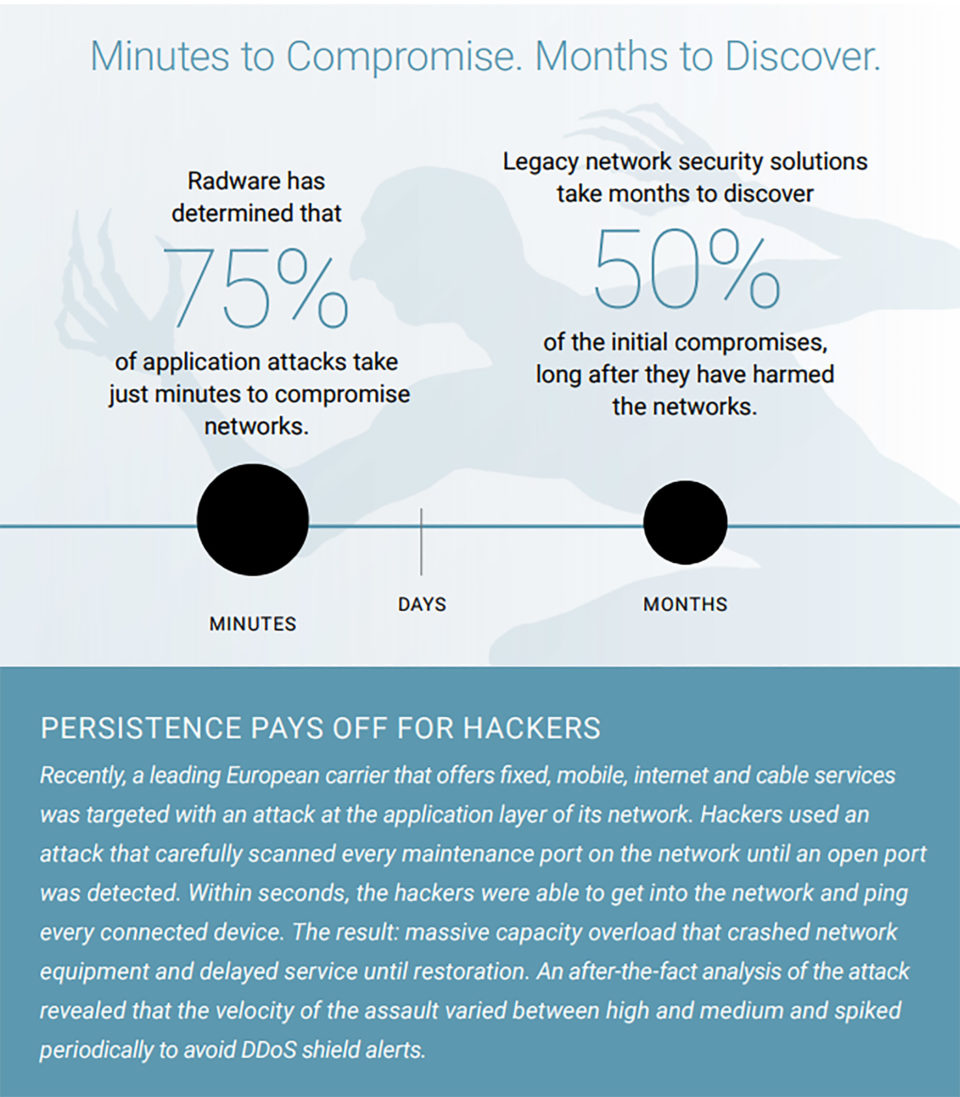
Always Under Attack
It’s safe for carriers to assume that their networks are always under attack. DDoS attack volume is escalating as hackers develop new and more technologically sophisticated ways to target carriers and their customers In 2018, attack campaigns were primarily composed of multiple attacks vectors, according to the Radware 2018–2019 Global Application & Network Security Report.
The report finds that “a bigger picture is likely to emerge about the need to deploy security solutions that not only adapt to changing attack vectors to mitigate evolving threats but also maintain service availability at the same time.”
Attack vectors include:
- SYN Flood
- UDP Flood
- DNS Flood
- HTTP Application Flood
- SSL Flood
- Burst Attacks
- Bot Attacks
Attackers prefer to keep a target busy by launching one or a few attacks at a time rather than firing the entire arsenal all at once. Carriers may be successful at blocking four or five attack vectors, but it only takes one failure for the damage to be done.